Smart Welfare Allocation
Industry
Public Sector
Client
Druskininkai Municipality
Team
BUILD
Year
2024
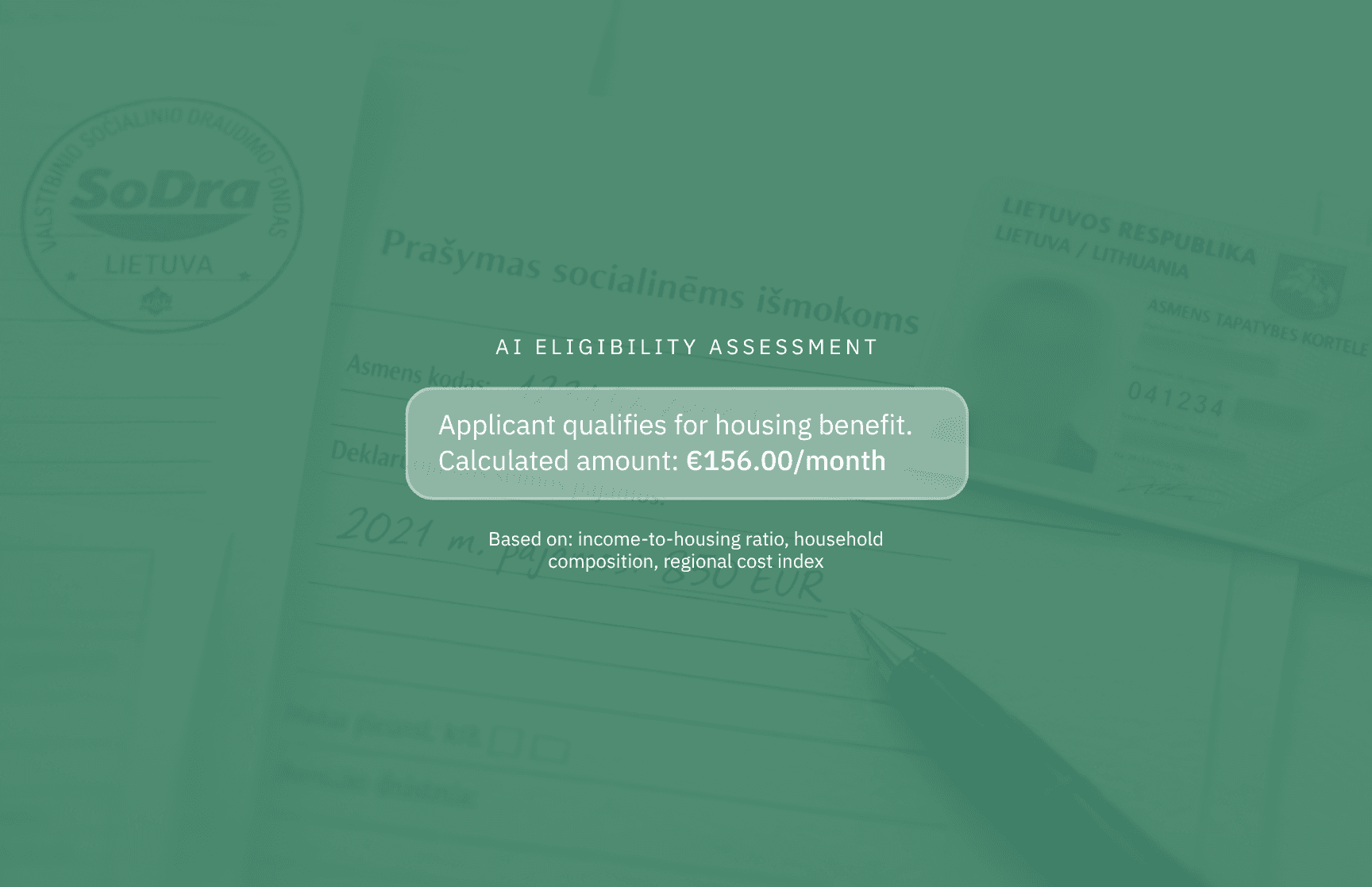
We were hired to build an AI-powered assistant that automates social benefit administration for a Lithuanian municipality, from scanning applications with OCR to validating eligibility against national registries and generating draft decisions for staff review.
Challenge
Processing social assistance applications at Druskininkai municipality was entirely manual: staff entered data by hand, validated documents against eligibility criteria, cross-referenced national registries, and drafted decisions for every single case. Each application required multiple steps of human review, creating bottlenecks that delayed benefit delivery to the low-income families, the elderly, and refugees who need it the most.
The volume of applications meant that administrative staff spent the majority of their time on repetitive data handling rather than case evaluation. Errors from manual data entry compounded the problem, causing incomplete applications to cycle back through the process and further extending wait times. The municipality needed a system that could absorb the repetitive processing work while maintaining the accuracy and compliance standards required for public welfare administration.
Approach
Built an OCR-powered document processing pipeline that automatically extracts and categorizes text from submitted applications across multiple formats (PDF, DOCX), ensuring all relevant information is captured without manual data entry.
Developed automated data validation that cross-checks applicant information against multiple national registries to verify eligibility, flagging incomplete or inconsistent applications before they reach human reviewers and eliminating the back-and-forth that slowed the manual process.
Created a decision support module that assembles validated data into preliminary decision projects so staff review a structured recommendation rather than building each decision from scratch.
Implemented automated citizen notifications that communicate application status, flag missing information, and send reminders, reducing the communication burden on staff while keeping applicants informed throughout the process.
Architecture/Backend
Multi-format OCR extraction; real-time Lithuanian national registry integration.
AI/ML models
AI document classification; automated validation against national registry records.
Infrastructure/Deployment
Automated intake-to-decision workflow; integrated citizen notification system.
Key results
Automated the end-to-end application intake process, from document scanning through eligibility validation, eliminating manual data entry and significantly reducing processing time per application.
Improved accuracy of eligibility determinations by cross-referencing applicant data against national registries in real time, catching inconsistencies that manual review frequently missed.
Reduced administrative workload by generating preliminary decision projects with built-in explanations, allowing staff to focus on case evaluation rather than data assembly.
Accelerated benefit delivery to vulnerable populations by removing the processing bottlenecks that had caused delays in the manual workflow.