Smart DLT Shareholder Voting
Industry
Government
Client
State Enterprise Centre of Registers
Team
BUILD
Year
2024
We were hired to build a voting module for shareholder meetings where every vote hits an immutable ledger the moment it's cast. It automates quorum checks, vote counts, and regulatory-compliant meeting minutes so that the things most likely to go wrong in a shareholder meeting can't.
Challenge
A shareholder meeting runs on three things: confirming enough people are present to make decisions (quorum), counting their votes accurately, and documenting what was decided in a format regulators accept. All three are traditionally manual. A registrar cross-references attendance against shareholder rolls. Votes are tallied by hand or basic software. Minutes are drafted after the fact and formatted to meet national requirements. Each step introduces delay, each is prone to human error, and none produces an inherently auditable record.
The State Enterprise Centre of Registers needed a system that makes these processes tamper-proof and automatic. The bar was trust. Shareholder votes determine corporate governance decisions, and any system recording them must guarantee that a vote, once cast, cannot be altered, lost, or disputed. The system also had to work with existing shareholder databases and digital identity infrastructure, not replace them.
Approach
The architecture is built around a distributed ledger because immutability and auditability are the core requirements, and DLT provides both by design. Every vote is recorded on the ledger in real time, creating an unalterable trail that any party can verify independently.
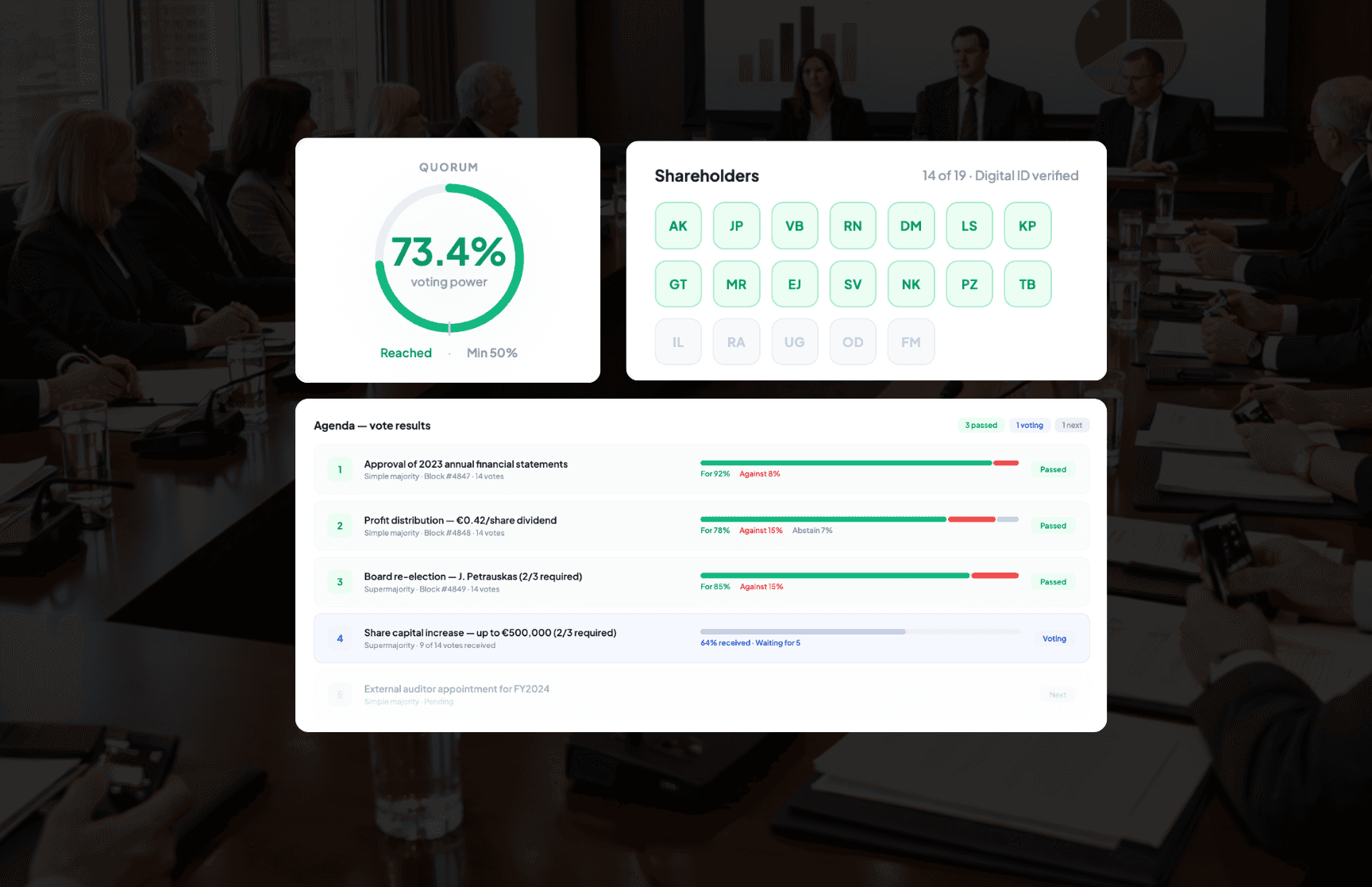
The voting interface lets shareholders authenticate with their digital identities and cast votes through a clean frontend. Behind it, the system validates participants against existing shareholder databases on connection, so quorum calculation starts the moment the meeting opens and updates live as attendees join. There's no waiting for a manual headcount since the system knows exactly how many eligible shares are represented at any given moment.
Vote counting runs on the ledger itself. As each vote is cast, it's simultaneously recorded and tallied, which means results are available the instant voting closes rather than after a counting process. This alone is projected to shorten meeting durations by up to 20%.
The most labor-intensive post-meeting task, drafting minutes, is automated entirely. The system generates meeting protocols from the recorded votes and decisions, formatted to meet national regulatory requirements. No one has to reconstruct what happened from notes; the ledger is the record. This is projected to cut protocol generation time by 30%.
The project is currently in prototype development with security testing underway. Next steps are integration with shareholder databases, live testing in actual meetings, and scaling for deployment across multiple organizations.
Architecture/Backend
DLT for real-time voting & quorum; shareholder DB sync; automated regulatory protocols.
AI/ML models
Live quorum validation; automated DLT vote counting; NLP-based minutes generation.
Infrastructure/Deployment
Phased rollout: prototype to multi-org; digital ID integration; security & compliance.
Key results
Every vote recorded on an immutable ledger the moment it's cast, which creates a tamper-proof, independently verifiable audit trail that eliminates disputes over what was decided and how.
Automated the three processes most likely to fail in shareholder meetings: quorum validation (real-time, as attendees join), vote counting (on-ledger, instant results), and minutes generation (automatic, regulation-formatted).
Projected 30% reduction in protocol generation time and up to 20% shorter meetings through real-time counting and automated documentation that reclaims hours currently spent on manual tallying and post-meeting drafting.
Plugs into existing shareholder databases and digital identity systems rather than replacing them, lowering the adoption barrier for organizations that need the transparency guarantees without a full infrastructure migration.