Smart Heritage Maintenance
Industry
Preservation
Client
Fixus Mobilis / Centre for Cultural Infrastructure
Team
BUILD
Year
2024
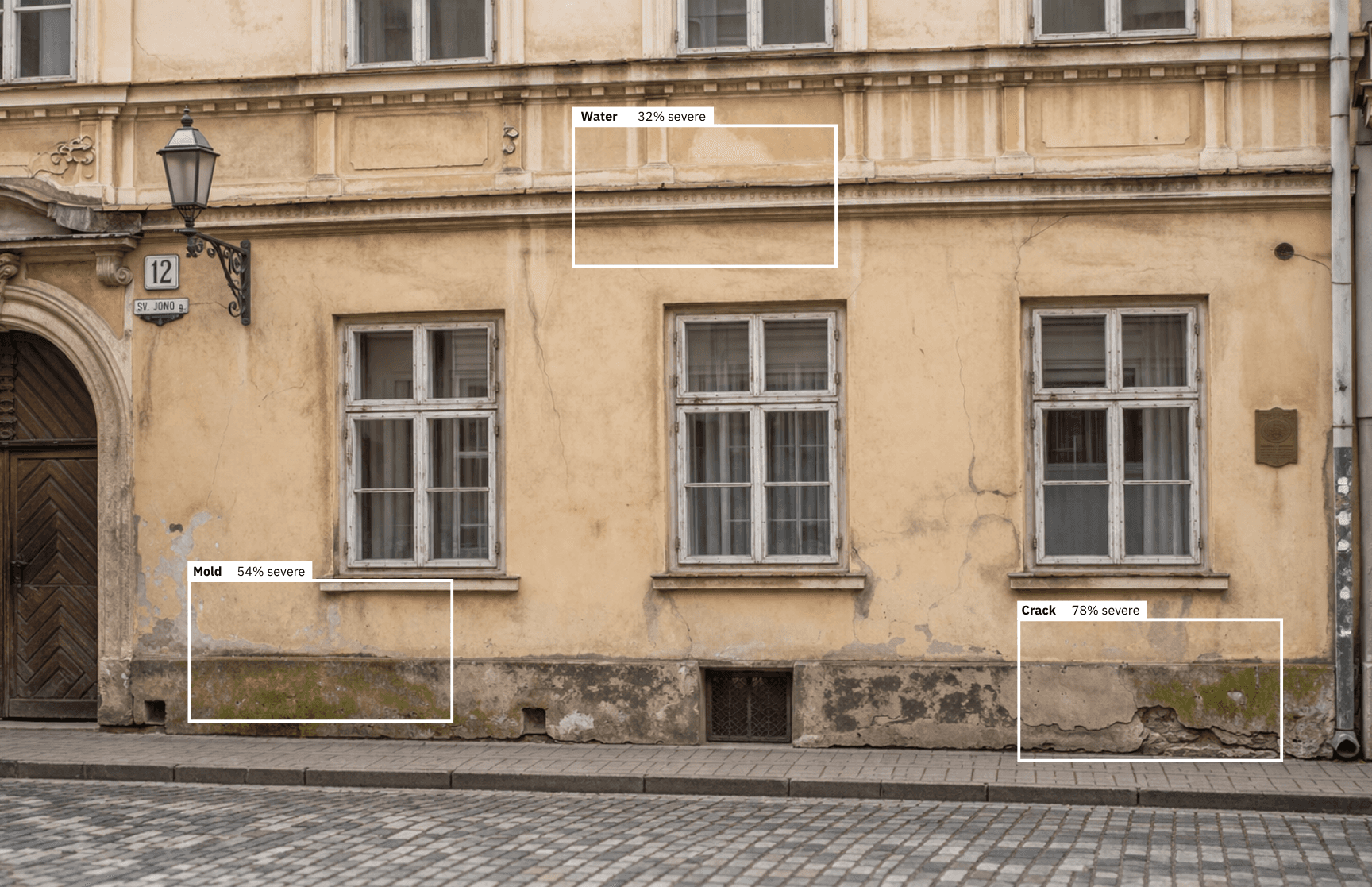
We were hired to build an AI platform that reads photos of historic buildings, detects structural damage human inspectors miss, and turns findings into calendar-synced maintenance plans, scaling Lithuania's heritage preservation from 70 annual site visits to any building with a camera.
Challenge
Lithuania has over 26,000 historic buildings. Fixus Mobilis, the preventive care arm of the Centre for Cultural Infrastructure, has three mobile teams that visit 70 of them per year. At that rate, a given heritage site might wait decades between professional inspections, during which a hairline plaster crack becomes a structural problem and early-stage wood rot becomes an expensive restoration project.
Even when inspectors reach a site, manual visual assessments miss damage that isn't obvious to the eye like mold behind surfaces, stress fractures in early stages, or rot that hasn't yet reached the exterior. By the time these issues are visible, the window for cheap preventive maintenance has closed. The alternative is costly restoration, and for some buildings, the damage is irreversible. Fixus Mobilis needed to decouple their monitoring capacity from the number of people they could physically send to sites.
Approach
The platform turns a smartphone photo into a maintenance plan in four steps.
First, custom convolutional neural networks. trained on over 5,000 annotated images of historic buildings, analyze uploaded photos for structural damage. The system detects cracks, rot, mold, and other deterioration patterns, and unlike a human inspector's binary judgment, it outputs percentage-based severity assessments that quantify how far damage has progressed.
Second, an NLP layer translates the detection results into plain-language maintenance reports. Rather than delivering raw model output, the system explains what was found, how severe it is, and what specific preventive steps should be taken. This makes the tool usable by building caretakers.
Third, detected issues feed directly into calendar integration with Google and Outlook. Maintenance tasks get suggested timelines and sync as calendar reminders, closing the gap between "damage identified" and "repair scheduled" that had been one of the biggest failure points in the manual process.
The full workflow, enter building details, upload photos, receive analysis, generate maintenance plan, lives on the Fixus Mobilis web platform. Beta testing with real users shaped both the detection accuracy and the interface, with continuous iteration on how damage assessments and recommendations were presented.
Architecture/Backend
Fixus Mobilis image pipeline; NLP report generation; Google/Outlook calendar integration.
AI/ML models
CNNs on 5k+ historic images; NLP maps damage detections to maintenance recommendations.
Infrastructure/Deployment
Beta-tested web platform; calendar scheduling; built for non-technical caretakers.
Key results
Broke the inspection bottleneck: any building caretaker with a phone can now submit photos for AI damage analysis, expanding monitoring reach far beyond what three mobile teams visiting 70 sites per year could cover.
Detected structural damage including cracks, rot, and mold with percentage-based severity scoring, catching early-stage issues that manual visual inspection routinely misses.
Connected detection to action through NLP-generated maintenance reports that sync directly to Google and Outlook calendars, eliminating the delay between identifying damage and scheduling repairs.
Shifted Lithuania's heritage preservation model from reactive restoration to preventive maintenance, where catching a crack early costs a fraction of restoring a wall later.