Multilingual AI Sales Agent
Industry
B2B Sales
Client
Export Discovery
Team
SCALE
Year
2024
We were hired to build a multilingual AI calling system that automates thousands of B2B sales calls simultaneously, coaches human operators in real time, and reads emotional cues to adjust conversations mid-call across English, Spanish, and German.
Challenge
Export Discovery's outbound sales operation hit a scaling wall. Every call required a human operator, which meant throughput was directly proportional to headcount. New operators took time to ramp and there was no way to systematically read how a prospect was responding and adapt on the fly. Multiply that across three languages, English, Spanish, and German, and the inefficiencies compounded.
The company didn't want a simple auto-dialer. They needed a system that could handle routine outreach autonomously, give human operators live coaching during complex calls, and layer emotional intelligence into both modes to detect shifts in tone and adjust the conversation accordingly. Success meant shorter call handling times and measurably higher conversion rates across their B2B pipeline.
Approach
The system operates in two modes that share a common AI backbone.
In fully automated mode, it conducts thousands of simultaneous outbound calls, processing conversation context in real time and generating responses with language-appropriate phrasing and emotional calibration. This handles the volume of routine B2B outreach that previously consumed operator hours without requiring the judgment of a live agent.
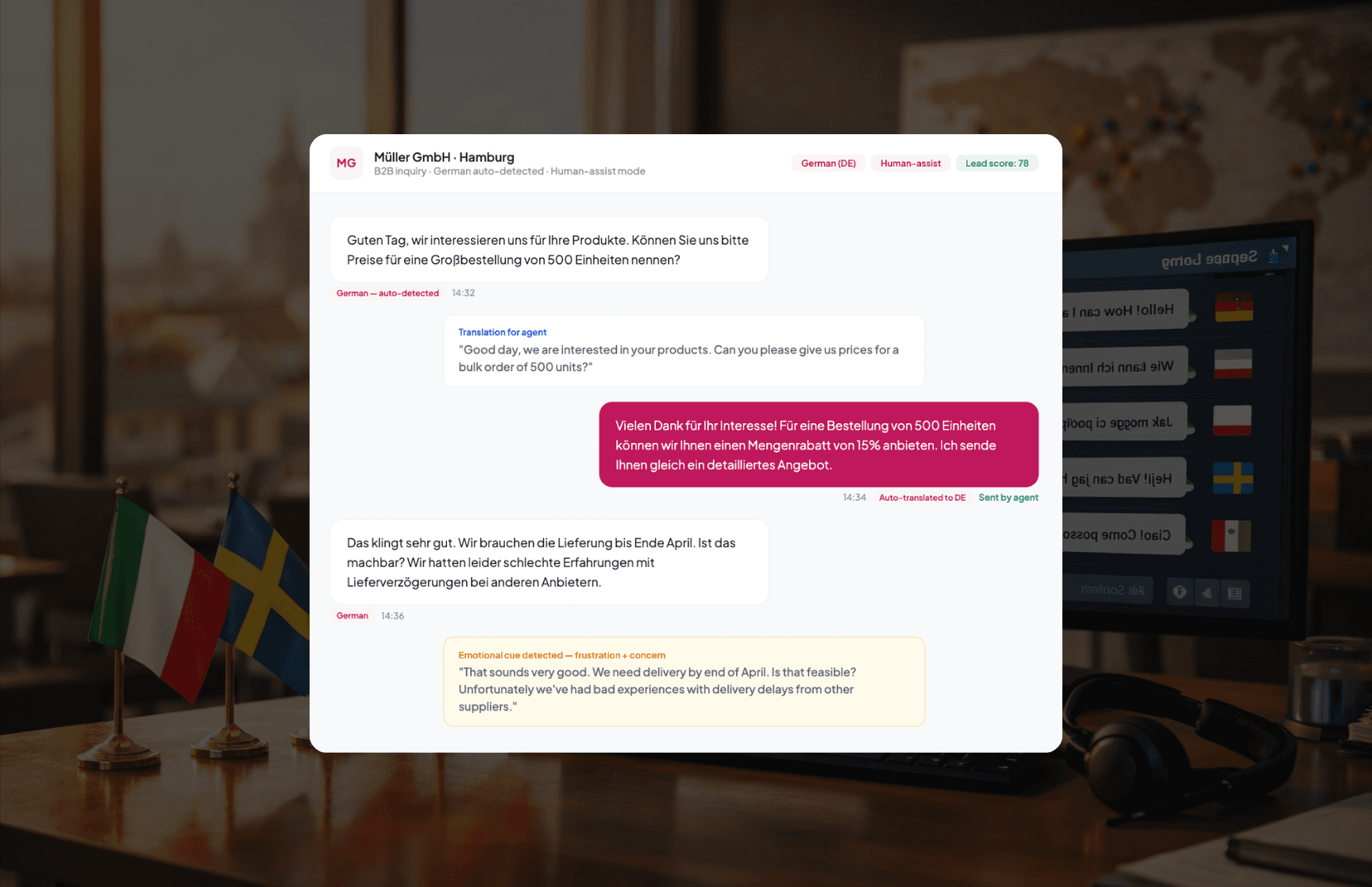
In operator-assist mode, the AI listens alongside a human caller and surfaces real-time suggestions , e.g. relevant arguments, objection responses, and contextual talking points, based on the live conversation flow. This collapses the learning curve for new hires and sharpens the performance of experienced operators by giving them data-driven prompts rather than static scripts.
Underlying both modes is an emotional and voice analysis layer that monitors tone, pacing, and emotional cues throughout each call. Rather than following a rigid call flow, the system detects when a prospect's engagement shifts and adjusts its approach or prompts the operator to do so. This is what turns a scalable calling system into one that actually converts.
The build followed a phased approach: model research and selection, training on call transcripts and customer interaction data, CRM integration, controlled pilot with a selected operator group, then iterative refinement before full-scale rollout.
Architecture/Backend
Parallel AI pipeline for thousands of concurrent calls; unified CRM integration.
AI/ML models
LLaMA for multilingual NLP; Whisper/Wav2vec speech; RL for emotional optimization.
Infrastructure/Deployment
Phased rollout (pilot to production); feedback loop for ongoing model refinement.
Key results
Broke the one-operator-per-call bottleneck with an automated system handling thousands of simultaneous outbound calls across three languages, decoupling throughput from headcount.
Cut the operator ramp-up problem by providing real-time AI coaching during live calls like contextual suggestions and objection handling that made new hires effective faster and experienced operators sharper.
Added emotional intelligence to the sales pipeline through voice and tone analysis that adapts conversation flow to prospect responses in real time, replacing static scripts with dynamic engagement.
Targeting a 30% reduction in call handling time and 20–30% improvement in B2B conversion rates through the combined effect of automation, live coaching, and emotional calibration.