AI for Timber Sector
Industry
Forestry
Client
Private Client
Team
BUILD
Year
2024
We were hired to build computer vision models that read log piles, spot wood defects humans miss, and monitor forest health from satellite imagery, giving timber operators AI-driven accuracy at every stage of the supply chain.
Challenge
The timber industry runs on measurement, and most of it is still done by hand. Estimating the volume of a log pile traditionally means either water displacement (impractical at scale) or sensor-equipped machines that still need significant human input. Defect detection relies on visual inspection, which catches surface issues but routinely misses internal rot and structural weaknesses hidden beneath the bark. And at the forest level, operators lack the real-time data needed to forecast yields or respond to shifting market demand before margins erode.
Each of these gaps compounds through the supply chain. A miscounted pile becomes a misquoted order; a missed defect becomes waste at the mill; a late demand signal becomes unsold inventory. The client needed a system that could measure what manual methods couldn't scale and deliver data fast enough to act on.
Approach
The solution spans three interconnected computer vision capabilities, each targeting a different stage of the timber supply chain.
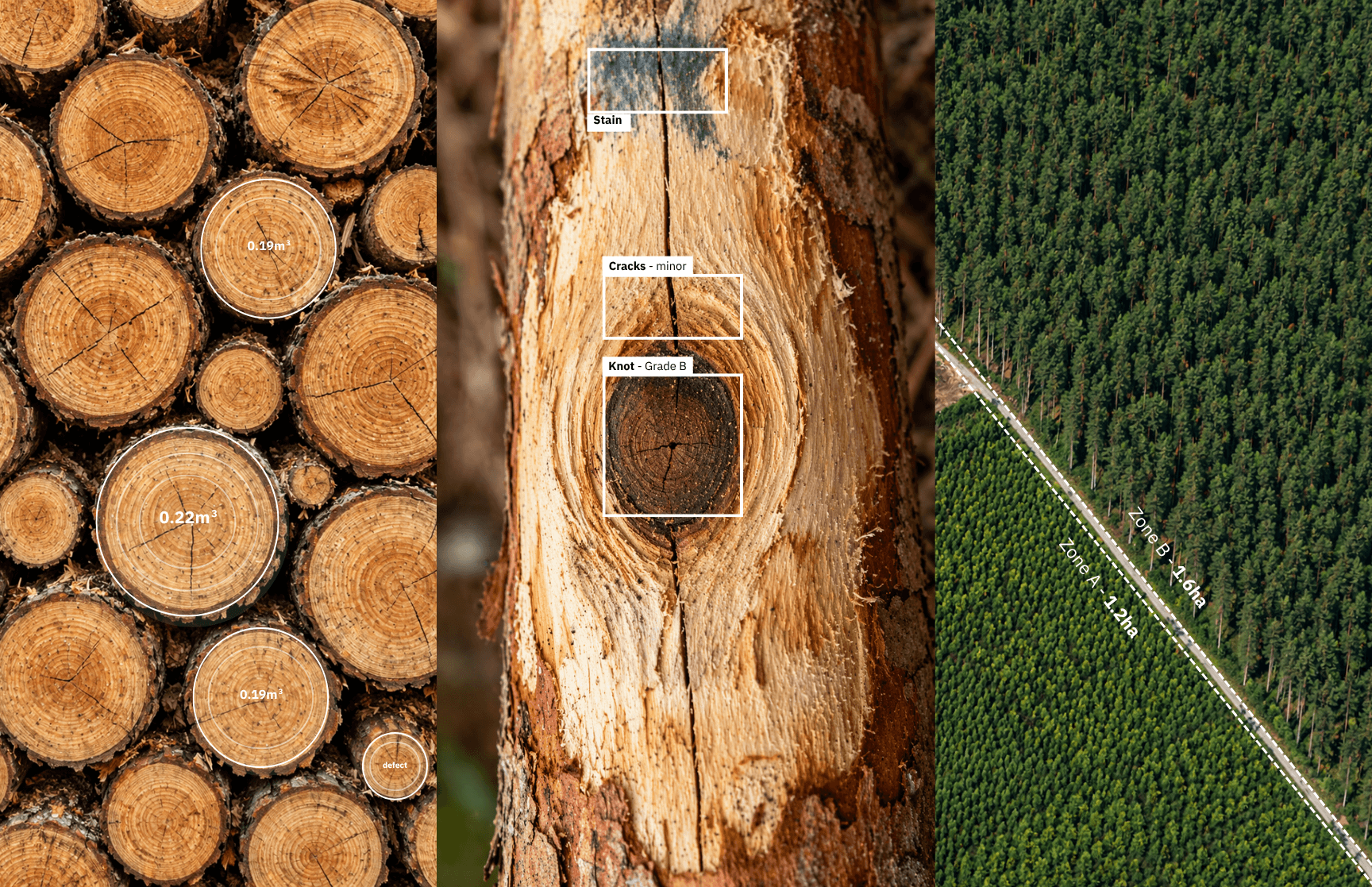
For volume estimation, we built image-based models that analyze photographs of log piles and sawn timber. The system distinguishes between wood types and calculates volumes directly from imagery, replacing both water displacement and sensor-based diameter measurement with a faster, more scalable approach.
For defect detection, we developed convolutional neural networks trained to identify splits, rot, disease, and structural issues from timber images, including problems invisible to the naked eye during standard inspection. Catching defects early in the processing chain means less waste at the mill and higher market value for the finished product.
At the forest level, we integrated satellite imagery analysis to classify cover types (deciduous vs. coniferous), monitor forest health indicators, and assess environmental factors like climate change impacts. This feeds directly into yield forecasting and sustainable resource planning, giving operators a longer planning horizon than ground-level observation alone can provide.
The three modules connect into a single data pipeline that gives operators real-time visibility from standing forest to processed timber, which enable faster responses to market shifts and more precise supply chain decisions.
Architecture/Backend
Timber & satellite image pipeline; connects volume, defect, and forest health modules.
AI/ML models
CNN defect detection; CV volume estimation; satellite forest cover & health monitoring.
Infrastructure/Deployment
Satellite forest monitoring; modular architecture for timber supply chain deployment.
Key results
Automated timber volume estimation from images, eliminating reliance on water displacement and manual sensor methods while improving measurement accuracy across wood types.
Identified wood defects — including subsurface rot and early-stage disease invisible to inspectors — earlier in the processing chain, reducing mill waste and increasing the value of finished timber.
Established satellite-based forest health monitoring that feeds yield forecasts and supports sustainable harvesting decisions, replacing reactive ground-level assessments.
Connected volume, defect, and health data into a single real-time pipeline, giving operators the supply chain visibility to optimize inventory and respond to market demand shifts before they impact margins.