AI for Detecting Kidney Stones
Industry
Healthcare
Client
Santaros Klinikos
Team
BUILD
Year
2024
We partnered with Lithuania's leading hospital to build an AI system that reads FTIR spectroscopy results in minutes, replacing the hours-long manual process that left nephrologists working from error-prone stone composition analyses.
Challenge
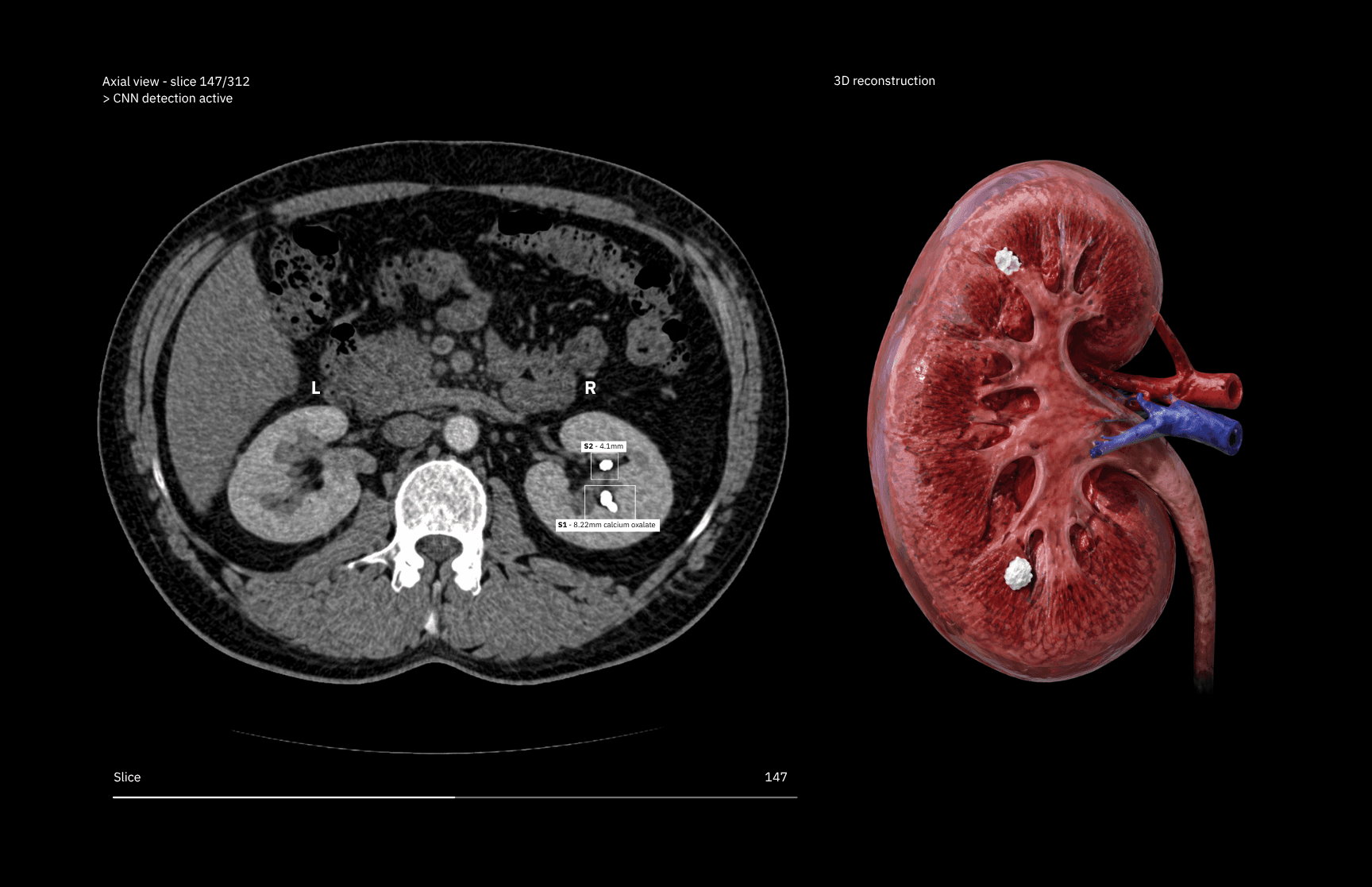
Lithuania performs roughly 3,000 kidney stone removal surgeries each year. After every one, the composition of the extracted stone needs to be accurately identified since it determines whether the patient ends up back in surgery.
At Santaros Klinikos, that analysis relied on Fourier-transform infrared (FTIR) spectroscopy interpreted manually by specialists. The method is sound, but the step was the bottleneck. It was prone to the kind of human error that leads to misidentified stone types. When a calcium oxalate stone gets classified as uric acid, the patient receives the wrong dietary guidance and the wrong medication. Misidentification also elevated risks of kidney infections and renal failure.
The hospital needed a system that could read FTIR spectra faster and more reliably than a human specialist, without sacrificing the nuance required to distinguish between compositionally similar stone types.
Approach
We built an AI system that automates the interpretation of FTIR spectral data. The core mechanism compares a patient's kidney stone spectrum (the unique infrared absorption pattern of their sample) against a comprehensive reference library of known stone compositions. This identifies the best matches and scores their likelihood.
The ML models were trained on hundreds of existing FTIR spectra to learn the spectral signatures of different stone types: calcium oxalate dihydrate, uric acid, struvite, and mixed-composition stones among them. Rather than outputting a single binary classification, the system assigns probability scores across candidate compositions to give clinicians a confidence-weighted result they can act on immediately.
This automated pipeline replaced the manual interpretation step entirely as it collapsed analysis turnaround from hours to minutes and removed the human-error bottleneck that had been the primary source of misdiagnosis. Doctors receive results fast enough to inform same-day treatment decisions.
The architecture was designed for extensibility. The same spectral analysis engine can be adapted to other FTIR applications: tissue sample analysis for cancer detection in oncology, drug purity verification in pharmaceuticals, contaminant screening in food safety, and pollutant identification in environmental monitoring.
Architecture/Backend
FTIR analysis pipeline; spectrum-to-composition matching against kidney stone library.
AI/ML models
Supervised ML on FTIR spectra; multi-class classification with likelihood scoring.
Infrastructure/Deployment
Santaros Klinikos workflow integration; architecture reusable for other spectroscopy.
Key results
Cut kidney stone analysis time by up to 80%, from hours of manual spectral interpretation to near-instantaneous automated classification, enabling same-day treatment planning.
Significantly improved diagnostic accuracy by eliminating the human interpretation bottleneck, reducing misidentification rates that had previously led to ineffective treatments and avoidable recurrence.
Enabled data-driven treatment plans at Lithuania's leading hospital, with confidence-scored composition results giving nephrologists the precision needed to tailor prevention strategies per patient.
Delivered a reusable AI spectroscopy platform with validated applicability beyond nephrology, extensible to oncology, pharmaceuticals, food safety, and environmental monitoring.